
Explore the Gold Rate in India from 1964 to 2026 with a year-wise price chart, historical trends, major milestones, and insights into gold’s long-term growth.
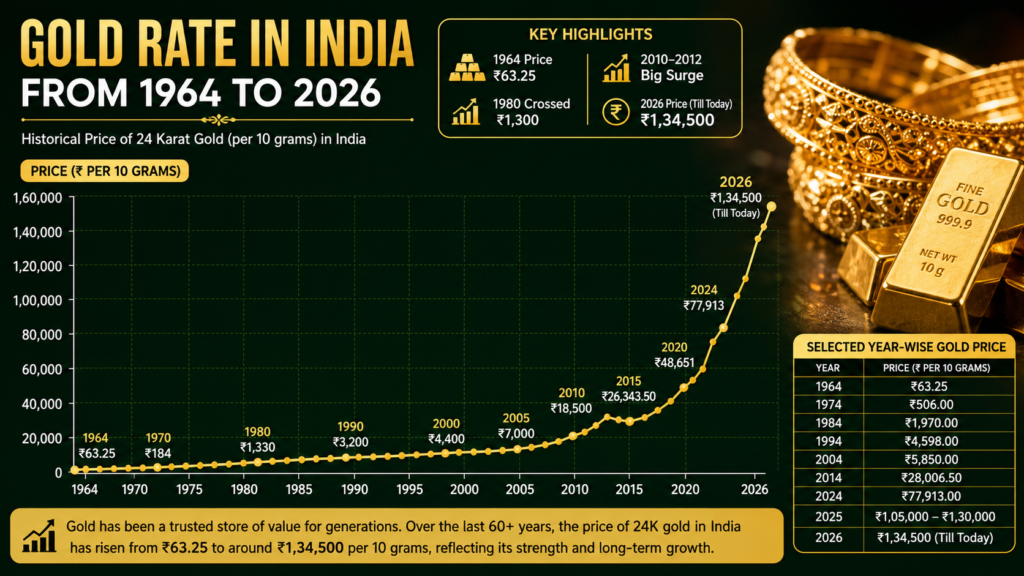
Gold has always been one of the most trusted investment options in India. Besides being an important part of Indian culture and traditions, it is considered a safe asset during periods of inflation, economic uncertainty, and financial instability. Over the last six decades, the price of gold has witnessed an extraordinary rise, increasing from just ₹63.25 per 10 grams in 1964 to around ₹1,34,500 per 10 grams in 2026. This remarkable growth highlights gold’s ability to preserve wealth and deliver long-term returns.
In the 1960s and early 1970s, gold prices in India remained relatively low and stable. The price was ₹63.25 per 10 grams in 1964, increasing gradually to ₹71.75 in 1965, ₹83.75 in 1966, and ₹102.50 in 1967. During the following years, gold prices remained below ₹200, reaching ₹176 in 1969, ₹184 in 1970, ₹193 in 1971, and ₹202 in 1972. At that time, gold was mainly purchased for weddings, festivals, and family savings rather than as a financial investment.
The first major increase in gold prices occurred during the 1970s due to global economic uncertainty, rising inflation, and the oil crisis. Gold prices climbed from ₹278.50 in 1973 to ₹506 in 1974 and ₹540 in 1975. Although prices briefly declined to ₹432 in 1976, they quickly recovered to ₹486 in 1977, ₹685 in 1978, and ₹937 in 1979. By 1980, gold crossed the ₹1,300 mark, reaching ₹1,330 per 10 grams, making it one of the most valuable investment assets in the country.
During the 1980s, gold continued to appreciate steadily. The price increased from ₹1,670 in 1981 to ₹1,645 in 1982, followed by ₹1,800 in 1983, ₹1,970 in 1984, ₹2,130 in 1985, and ₹2,140 in 1986. By 1987, gold reached ₹2,570, while it remained above ₹3,100 during 1988 and 1989. In 1990, the price touched ₹3,200 per 10 grams, reflecting strong domestic demand and increasing international gold prices.
The early 1990s marked another important phase for the Indian economy. Following economic liberalization in 1991, gold prices experienced moderate fluctuations. Gold was priced at ₹3,466 in 1991, ₹4,334 in 1992, ₹4,140 in 1993, ₹4,598 in 1994, and ₹4,680 in 1995. The price rose to ₹5,160 in 1996 before slightly declining to ₹4,725 in 1997, ₹4,045 in 1998, and ₹4,234 in 1999. Despite these short-term movements, gold remained one of India’s most preferred long-term investment options.
The beginning of the new millennium witnessed steady price growth. Gold was available at around ₹4,400 in 2000, ₹4,300 in 2001, and ₹4,990 in 2002. Prices gradually increased to ₹5,600 in 2003, ₹5,850 in 2004, and ₹7,000 in 2005. Although data for 2006 is unavailable, the upward trend continued, with prices reaching ₹10,800 in 2007, ₹12,500 in 2008, and ₹14,500 in 2009. Growing global demand, a weaker US dollar, and the global financial crisis significantly boosted gold prices during this period.
The decade beginning in 2010 saw one of the fastest increases in gold prices. Gold jumped from ₹18,500 in 2010 to ₹26,400 in 2011, reaching ₹31,050 in 2012, the highest level at that time. Although prices corrected slightly to ₹29,600 in 2013, ₹28,006.50 in 2014, and ₹26,343.50 in 2015, investors continued to consider gold a reliable hedge against inflation and market volatility. Prices began recovering again, touching ₹28,623.50 in 2016, ₹29,667.50 in 2017, and ₹31,438 in 2018.
A significant rally began after 2019, driven by global uncertainties, geopolitical tensions, and the COVID-19 pandemic. Gold increased from ₹35,220 in 2019 to ₹48,651 in 2020, one of the largest annual increases in history. Prices remained high at ₹48,720 in 2021 before rising further to ₹52,670 in 2022 and ₹65,330 in 2023. Strong central bank purchases, inflation concerns, and safe-haven demand played a major role in supporting these record prices.
The momentum continued in 2024, with gold reaching an average price of ₹77,913 per 10 grams. In 2025, prices surged further, trading between ₹1,05,000 and ₹1,30,000, marking one of the strongest rallies ever witnessed in the Indian gold market. By 2026, gold touched approximately ₹1,34,500 per 10 grams, setting a new all-time high. Rising global uncertainty, central bank buying, a weaker rupee against the US dollar, and sustained investor demand have all contributed to this exceptional rise.
Highest Change in Gold Rate in India
Looking at the journey from ₹63.25 in 1964 to ₹1,34,500 in 2026, gold has delivered remarkable long-term wealth creation. While prices have experienced occasional corrections, the overall trend has remained upward for more than six decades. This historical performance demonstrates why gold continues to be one of the most trusted investment choices for Indian households. Whether purchased as jewellery, coins, bars, or through digital investment options such as Gold ETFs and Sovereign Gold Bonds, gold remains an essential component of a diversified investment portfolio and a dependable store of value for future generations.
Gold Price Growth at a Glance
| Period | Gold Price | Growth |
|---|---|---|
| 1964 | ₹63.25 | Starting Point |
| 1974 | ₹506 | 8× increase in 10 years |
| 1984 | ₹1,970 | Crossed ₹1,000 during the 1980s |
| 1994 | ₹4,598 | Nearly doubled in a decade |
| 2004 | ₹5,850 | Stable growth |
| 2014 | ₹28,006 | Massive rally after 2008 |
| 2024 | ₹77,913 | Record highs after COVID-19 |
| 2026 | ₹1,34,500 | Highest price in history |
Key Highlights About Gold Rate in India
- 1964: Gold was priced at only ₹63.25 per 10 grams.
- 1980: Gold crossed ₹1,300 for the first time.
- 1991–2000: Prices remained between ₹3,200 and ₹5,200.
- 2010–2012: Gold surged from ₹18,500 to ₹31,050 in just two years.
- 2020: The COVID-19 pandemic pushed prices close to ₹50,000.
- 2024–2026: Gold witnessed its biggest rally, climbing from ₹77,913 to approximately ₹1,34,500 per 10 grams.
Gold Rate in India (1964–2026)
Historical 24K gold price per 10 grams in India.
| year | price |
|---|---|
| 1964 | 63.25 |
| 1965 | 71.75 |
| 1966 | 83.75 |
| 1967 | 102.5 |
| 1968 | 162 |
| 1969 | 176 |
| 1970 | 184 |
| 1971 | 193 |
| 1972 | 202 |
| 1973 | 278.5 |
| 1974 | 506 |
| 1975 | 540 |
| 1976 | 432 |
| 1977 | 486 |
| 1978 | 685 |
| 1979 | 937 |
| 1980 | 1,330 |
| 1981 | 1,670 |
| 1982 | 1,645 |
| 1983 | 1,800 |
| 1984 | 1,970 |
| 1985 | 2,130 |
| 1986 | 2,140 |
| 1987 | 2,570 |
| 1988 | 3,130 |
| 1989 | 3,140 |
| 1990 | 3,200 |
| 1991 | 3,466 |
| 1992 | 4,334 |
| 1993 | 4,140 |
| 1994 | 4,598 |
| 1995 | 4,680 |
| 1996 | 5,160 |
| 1997 | 4,725 |
| 1998 | 4,045 |
| 1999 | 4,234 |
| 2000 | 4,400 |
| 2001 | 4,300 |
| 2002 | 4,990 |
| 2003 | 5,600 |
| 2004 | 5,850 |
| 2005 | 7,000 |
| 2007 | 10,800 |
| 2008 | 12,500 |
| 2009 | 14,500 |
| 2010 | 18,500 |
| 2011 | 26,400 |
| 2012 | 31,050 |
| 2013 | 29,600 |
| 2014 | 28,006.5 |
| 2015 | 26,343.5 |
| 2016 | 28,623.5 |
| 2017 | 29,667.5 |
| 2018 | 31,438 |
| 2019 | 35,220 |
| 2020 | 48,651 |
| 2021 | 48,720 |
| 2022 | 52,670 |
| 2023 | 65,330 |
| 2024 | 77,913 |
| 2025 | 1,17,500 |
| 2026 | 1,34,500 |
Keep visiting The Ganga Times for such beautiful articles. Follow us on Facebook, Twitter, Instagram, and Koo for regular updates.